
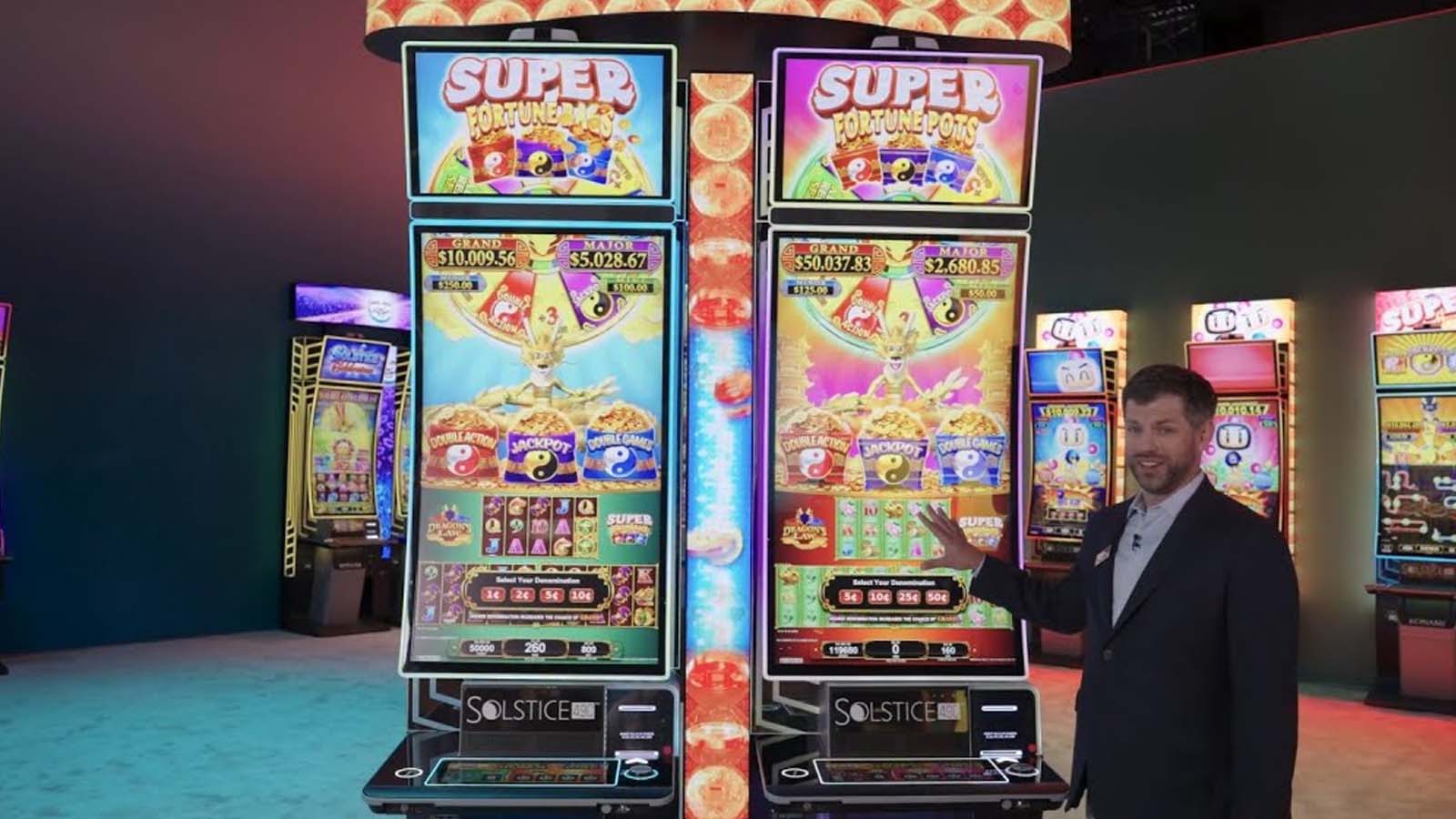
- Konami published no theoretical payout percentage for any announced title, land-based or online.
- A third bonus tier moves money around inside a machine’s payback rather than adding to it.
- Nevada requires a gaming device to theoretically return at least 75% of each wager available for play.
- Konami will show more than 50 new game themes across five hardware form factors at G2E in September.
LAS VEGAS – Konami Gaming announced an 11-foot slot cabinet with a triple bonus game Aug. 6 and disclosed no theoretical payout percentage for it, or for any of the more than 50 new game themes on its trade-show slate.
The cabinet extends the company’s Dragon’s Law Fortune series and headlines a lineup spread across five hardware form factors, all bound for the Global Gaming Expo in September.
More Than 50 Themes Across Five Form Factors
The slate spreads across five hardware form factors, with the oversized cabinet as the headline debut. A second new machine, a stacked-screen unit, launches Bull Blitz Rampage as a brand extension of a title Konami says proved itself in the Australian market. On the online side, Konami Online Interactive brings titles including Money in the Bank and Diggin’ Bros.
The games span Class III, Class II, historical horse racing, video gaming terminals and iGaming, the company said in its G2E announcement, a spread that reaches most of the types of slot machines a US floor puts out. “Dependable partnership defines how we build, advance, and innovate product,” president and chief operating officer Tom Jingoli said in the release.
None of that tells a player what the games return. The percentage a machine pays back is the one number that decides what it costs to play, and trade-show slates rarely carry it.
A Third Bonus Tier Moves Money Around Rather Than Adding Any
A slot machine’s theoretical return is a property of its math, set in the par sheet the manufacturer submits for approval. At any one of those settings the return is a closed budget, and a third bonus tier does not enlarge it. It moves money inside it.
Every dollar routed into a bonus level comes out of somewhere else, which in practice means the base game hits smaller, hits less often, or both. That is a trade in volatility, not a gain in payback, and without that number no one on the floor can tell which way a given machine was set.
The same logic governs the cabinet itself. Eleven feet of screen, a taller sign and a bigger bonus display are merchandising, and merchandising has no input into the random number generator. The odds of any given spin are set in the math, and the math does not know how tall the box is. That separation between the presentation and the arithmetic is the core of how slot machines work, and it holds no matter what the cabinet looks like.
Nevada writes the point into regulation. All possible game outcomes must be available at the start of every play, Regulation 14.040 states, so a bonus tier cannot lock a top award behind a gate. The same section bars a device from altering any function based on its actual hold percentage, which is the regulatory way of saying a machine cannot tighten up because it just paid.
Nevada’s Floor Is 75%, And The Cabinet Does Not Set It
Regulation 14.040 sets the minimum. A gaming device has to theoretically return “not less than 75 percent for each wager available for play on the device,” and the figure must be mathematically demonstrable across everything wagered through it. A machine sitting on that floor keeps $25 of every $100 wagered over the long run. It is a floor rather than a target, and it is also the only payout number in the picture that is public.
What a specific machine actually returns is chosen further down the chain. Manufacturers submit a game at several approved par settings, and the casino ordering the box selects one. Two identical Konami cabinets on two different floors, running the same theme, can be set to different returns, and nothing on the glass tells a player which is which.
The regulation forces consistency in one narrow case. Devices connected to a common payoff schedule have to carry equivalent odds of winning it, and where denominations differ the expected value must be equalized within a 1% tolerance on return to player. A bank of linked machines cannot quietly run at two different prices on the award they share.
For players in states with slots, that is the practical translation of every trade-show reveal. The hardware is what the operator buys. The return is what the operator selects.
What Happens Next
G2E runs Sept. 29 to Oct. 1 at the Venetian Expo in Las Vegas, where Konami will take booth #1256 and open the lineup to operator testing. Konami has not set launch dates for the oversized cabinet or Bull Blitz Rampage, and the games cannot reach a Nevada floor until they clear device approval, which ends with the Gaming Control Board’s chair or the Nevada Gaming Commission.
